
 JYSK Delivery Service
 Become a Driver
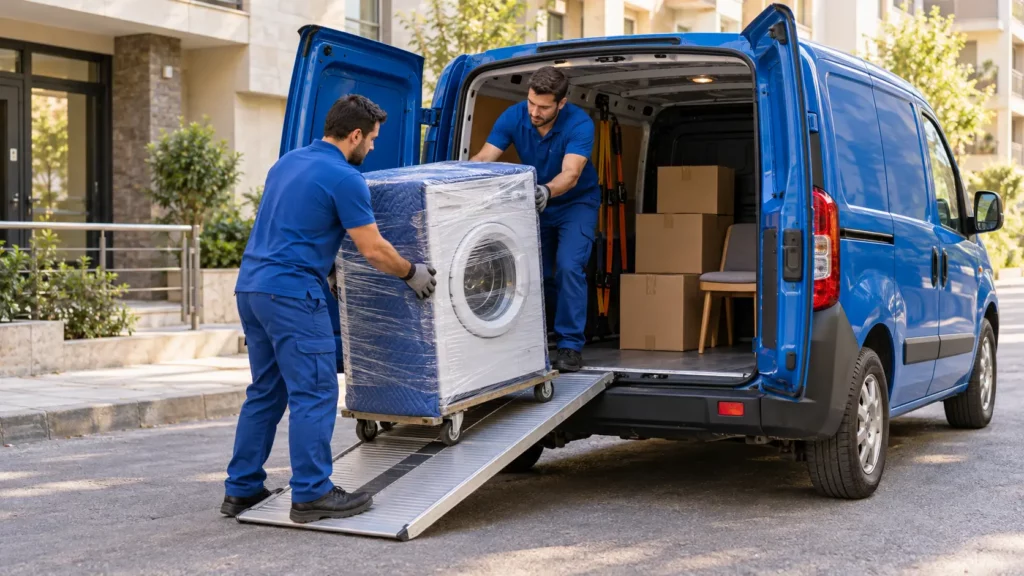
In situations such as moving house, buying second-hand goods, replacing appliances, or sending items to a relative, only the washing machine may need to be transported. When such a need arises, one of the most frequently asked questions is, "Is a Doblo sufficient for transporting a washing machine?" Many standard-sized washing machines can be transported in light commercial vehicles like the Doblo, which have a suitable interior space. However, simply checking if the machine fits in the vehicle is not enough. The size and weight of the machine, the usable cargo space of the vehicle, its ability to be kept upright during transport, loading support, and information about floors and elevators should all be considered together.
From the outside, a washing machine may appear to be a single, easily transportable appliance. However, inside, it contains delicate components such as the drum, shock absorbers, electronic circuit board, pump, hoses, and fittings. Sudden movements during transport, tilting the machine in the wrong direction, or insufficient securing within the vehicle can put stress on these parts. Therefore, even if a small transport vehicle is sufficient for moving a washing machine, careful planning of the preparation, loading, and securing stages is necessary.
What are the dimensions of a standard washing machine?
Most standard front-loading washing machines are approximately 60 cm wide, 55-65 cm deep, and 84-85 cm high. Model capacity, design, and drum volume can cause variations in these measurements. Slimmer models may have less depth, while high-capacity, dryer-equipped, or professional machines may be wider and heavier. The machine's door, buttons, water connections, and protrusions on the back can also add a few centimeters to the overall dimensions.
The weight of a washing machine is usually not determined solely by its external dimensions. While standard models typically range from approximately 55-85 kilograms, high-capacity or dryer models can be heavier. Because the appliance contains internal weights for stability, even an empty washing machine may require two people to lift it carefully. Therefore, both the machine's footprint and its total weight should be considered when choosing a machine.
When taking measurements, not only the device body but also the protective packaging to be used should be taken into account. Using bubble wrap, cardboard corner protectors, blankets, or appliance transport covers may increase the width and depth of the machine by a few centimeters. The rear door opening and interior height of a Doblo-type vehicle must be suitable for loading the packaged machine vertically.
Will a washing machine fit in a Doblo?
A single standard-sized washing machine fits into the cargo space of most Doblo-type light commercial vehicles. According to estimated vehicle information on Taşımacım, the maximum cargo space for a Doblo is approximately 1,5 × 1,2 × 1,2 meters, with a weight limit of 200 kilograms. The example capacity includes a washing machine along with several medium-sized boxes, two chairs, and a small table. These values generally indicate sufficient capacity for transporting a standard washing machine alone in a Doblo.
However, the body structures and interior dimensions of light commercial vehicles categorized under the name "Doblo" may vary depending on the model. Passenger versions with rear seats and enclosed body models dedicated entirely to cargo may not have the same usable volume. The way the rear door opens, the height of the door sill, interior compartments, and other materials in the vehicle can also affect the usable space. Therefore, a definitive decision should not be made based solely on the vehicle name without checking the dimensions.
While a Doblo is often sufficient for a standard washing machine, the total volume should be recalculated if you're also transporting a dryer, refrigerator, dishwasher, furniture, or numerous boxes. It may not be possible to place two appliances side-by-side or safely back-to-back. In this case, choosing a larger vehicle such as a panel van or pickup truck might be more appropriate.
In what situations might a Doblo not be sufficient?
If your washing machine has non-standard dimensions, the Doblo may not be suitable. Machines that combine washing and drying functions, high-capacity models, industrial machines, or those used in professional laundries can be heavier and larger than standard household products. The weight information on the product's technical label and the external dimensions provided by the manufacturer should be checked before selecting a vehicle.
If other items are to be transported along with the washing machine, it's not enough to simply check if each item fits in the vehicle individually. Protective spacing may be necessary to ensure items are securely placed within the vehicle. For example, if a television, mirror, or glass furniture is being transported along with the washing machine, pressure should not be applied to delicate items. Even if all items appear to fit in terms of volume, a larger vehicle should be chosen if a safe loading arrangement cannot be created.
The Doblo option does not automatically provide the necessary manpower for loading and unloading. The vehicle's capacity does not mean the driver can single-handedly carry the washing machine up and down the stairs. Additional assistance may be required if the building where the machine is to be picked up or dropped off does not have an elevator, the stairs are narrow, or the vehicle cannot approach the building. This information must be clearly stated when placing the order.
How to Measure a Washing Machine Before Choosing a Machine?
For accurate measurement, the width, depth, and height of the machine must be determined separately. The width should be measured between the right and left sides of the device; the height from the feet touching the ground to the top surface; and the depth from the outermost point of the front cover or control buttons to the rear connection protrusions. The detachability of the rear hoses may affect the measurement, but fixed protrusions on the device's body must be taken into account.
The additional thickness that will be created after the machine is packaged should also be taken into account. If protective covers, cardboard, and bubble wrap are to be used, a small safety margin can be added to the dimensions. Since the device is planned to be transported in an upright position, it should be checked whether the packaged height passes through the vehicle's door opening. Once the machine is inside the vehicle, it should not touch the ceiling, and there should be enough space for the use of securing equipment.
It is important to record measurements in centimeters and enter them correctly during ordering. Approximate or estimated information can lead to incorrect tool selection. If the machine's make and model are known, the dimensions in the manufacturer's technical documentation can also be checked. However, due to packaging and protrusions, physical measurement provides a more reliable result.
How to Prepare a Washing Machine Before Moving?
Before moving the washing machine, ensure that all electrical and water connections are securely disconnected. First, make sure there is no program running and unplug the machine. Then, close the water inlet valve, carefully disconnect the inlet hose, and drain any remaining water. Since some water may remain in the drain hose, have a bucket, towel, or suitable container ready to prevent the floor from getting wet.
Water remaining in the machine's pump filter and around the drum may also leak out during transport. The drainage method specified in the manufacturer's user manual should be followed, and the inside of the appliance should be allowed to dry as much as possible. Taking the machine out of service, preferably a day in advance rather than just a few hours before transport, may provide sufficient time for preparation. However, the instructions in the appliance's user manual should be used as a guide for the correct timing and drainage procedure.
The power cord, water inlet hose, and drain hose should not be left haphazardly on top of the machine. Cables and hoses should be collected separately, coiled securely to prevent kinks, and fastened to the back of the appliance to prevent movement. Any fittings to be transported with the machine can be kept in a labeled bag. It is important to avoid losing any gaskets, fittings, and hose parts that may be needed during installation at the new location.
The inside of the machine should be checked and no clothes or foreign objects should be left in the drum. The detergent drawer should be emptied and cleaned, and the surfaces dried. The removable detergent drawer can be packaged separately according to the model's instruction manual. The appliance door should be protected from opening during transport, but strong tape should not be applied directly to the door surface. Tape may leave marks on plastic or painted surfaces.
Why are mounting screws important?
The drum inside the washing machine moves on spring and damper systems that reduce vibration during operation. While this movement is necessary during normal use, strong jolts during transport can cause stress on the drum and surrounding components. Transport screws are used to limit the uncontrolled movement of the drum during transport.
When the machine is first purchased, the mounting screws located on the rear are removed during installation and it is recommended to save them for future use. If screws are present, they should be reinstalled according to the manufacturer's instructions. The screw location and installation method may not be the same for each model; therefore, screws from another machine or unsuitable fittings should not be used. Incorrect screw installation can also cause damage to the device.
If the transport screws are missing, the appropriate parts can be obtained by consulting the authorized service center or manufacturer of the machine. If transport becomes necessary without the screws, the manufacturer's guidance should be sought for a safe method to be applied. Stuffing towels, blankets, or other materials inside the drum, if not specified by the manufacturer, may damage the internal parts of the device.
Upon arrival at the new address, the transport screws must be removed before the machine is started. Operating the device with the screws in place can cause excessive vibration and mechanical problems. Therefore, the presence of the transport screws must be clearly communicated to the person installing the machine at the new address.
How should a washing machine be packaged?
Before packaging, the machine's exterior must be clean and dry. A soft blanket, appliance transport cover, or foam material can be placed around the appliance as a first layer of protection. Corners, being high-risk areas, should be reinforced with cardboard or special corner protectors. Stretch film can then be used to prevent the protective material from moving.
Stretch film alone does not provide direct protection against impact. Its primary purpose is to keep blankets or cardboard boxes in place. Therefore, a machine wrapped in only a few layers of stretch film should not be considered sufficiently protected. The control panel, program knob, detergent drawer, and door area, in particular, must be protected from pressure.
Instead of directly applying packing tape to the surface of the appliance to keep the machine lid closed, it can be secured through the protective packaging. The power cord and hoses should not be left under the machine or dragged along the ground during transport. The packaging should be prepared in a way that does not prevent the machine from being lifted or placed on a transport device.
The machine needs protection from water in rainy weather. However, it should not be assumed that the device, being a water-operated product, can be left unprotected in the rain. The electronic panel, connections, and housing joints may be exposed to external water. The machine must be properly enclosed during transit from the building to the vehicle.
Should a washing machine be moved upright?
It is generally preferable to transport a washing machine in an upright position. Upright transport ensures that the appliance remains in the position closest to its intended use and allows for more controlled protection of the drum system. Tilting the machine on its side or rear can cause stress on internal mechanisms, hoses, or exterior panels. Furthermore, water remaining inside the appliance can reach areas containing electronic components.
However, since the structure of each model may differ, the instructions in the manufacturer's user manual should be followed regarding the transport position. It may be necessary to tilt the machine briefly to move it over a narrow staircase. This should be done carefully; the device should not be released suddenly, and it should be returned to an upright position as quickly as possible.
When choosing a Doblo-type vehicle, it is important to ensure that the machine can pass through the door vertically and stand upright in the loading area. Fitting the machine into the vehicle by laying it down is not a good vehicle choice. If the vehicle's interior height does not allow for the vertical transport of the packaged machine, a more suitable vehicle should be chosen.
How should the machine be loaded into the Doblo?
Washing machines are heavy and difficult to grasp. Their flat exterior can limit secure grip points. Therefore, it is risky for one person to carry the appliance down stairs or into a vehicle. At least two people should move it safely during loading, and a suitable lifting sling or appliance trolley may be required.
The vehicle's rear door must be fully opened, and other items in the loading area should be arranged beforehand. The machine should not be dragged; it must not be struck against the ground, door sill, or the vehicle's bumper. If there is a height difference between the vehicle and the pavement, a suitable ramp or lifting equipment may be used. Lifting the device by its feet or cover is incorrect.
The machine should be placed on the flattest possible surface inside the vehicle. Load securing straps should be used to prevent the machine from tipping, sliding, or hitting walls while the vehicle is in motion. The straps should be threaded through the machine without applying excessive pressure to the control panel or cover. A protective blanket can be placed between the machine and the metal surfaces of the vehicle.
Heavy items should not be placed on top of the washing machine. Boxes placed next to it should not be arranged in a way that will compress the machine or put pressure on its door. If there are other items in the vehicle, the loading order and weight distribution should be balanced. The machine should not be able to move independently while being driven.
Why Should Floor, Elevator, and Transportation Support Be Specified?
Fitting the washing machine into the Doblo is only part of the moving process. Planning for removing the appliance from the old house and delivering it to the new address is also necessary. The floor information of the pickup and delivery addresses, whether the building has an elevator, and whether the machine will fit in the elevator should be checked in advance.
In a high-rise building without an elevator, carrying a washing machine down the stairs can require more manpower and time. Narrow stair turns, small doorways, or steps at the building entrance can all affect the method of transport. Special slings or a trolley may be needed to move the machine up and down the stairs.
The process is also prolonged if the transport vehicle cannot approach the building entrance. Narrow streets, gated community entrances, busy parking areas, and vehicle height restrictions should be evaluated beforehand. If the machine will be transported a long distance by hand or on a transport cart, this should be indicated during the ordering process.
When creating a request through my transporter, instead of just selecting a vehicle, you should also specify whether door-to-door delivery support is required. It should not be assumed that the driver will carry the device alone. If there are no people to assist at the addresses, the required delivery support should be added to the order.
Can other items be placed next to the washing machine?
As long as the Doblo's load capacity allows, you can transport a few boxes or small items along with the washing machine. However, the total weight, volume, and safe placement should be considered together. Taşımacım's example capacity for the Doblo includes items such as a washing machine, three medium-sized boxes, two chairs, and a small table. This list is an estimated example; the capacity will change if the actual dimensions of the items are different.
Boxes should be placed next to the washing machine, not on top of it, and secured in a way that prevents movement. Boxes filled with heavy items like books can affect the weight distribution of the vehicle. It is not advisable to lean glass, televisions, mirrors, or delicate electronic devices against the washing machine. If the machine moves during driving, it could damage these items.
If a dryer is also to be transported along with the washing machine, the total dimensions of both appliances should be measured, and a protective gap should be left between them. If both appliances cannot be placed in an upright position, a larger vehicle such as a panel van can be chosen. While increasing the size of the vehicle may sometimes seem like an unnecessary expense, it may be necessary for transporting the items without compressing them and in the correct position.
Should you choose a Doblo or a Panel Van?
If you're only transporting a standard washing machine and a few small boxes, a Doblo is usually sufficient. However, if you're transporting a large number of boxes, a dryer, a dishwasher, a sofa, or other large furniture along with the washing machine, a panel van might be more suitable. The panel van's larger interior space makes it easier to place items upright with protective spacing between them.
When making a decision, the question should be "Can the items be safely placed and secured?" rather than "Will the items fit somehow?". Completely filling the vehicle doesn't always mean it's the right transport plan. Sufficient protective space must remain around sensitive equipment.
When undecided, the dimensions of the machine and other items should be written down individually, photographs prepared, and an evaluation made based on the total list of items. The fact that the machine appears large based on its make or model is not the sole determining factor; technical measurements provide a more reliable decision.
How to Plan Washing Machine Transportation with a Moving Company?
When placing a washing machine transport order through Taşımacım, the first step is to enter the pickup and delivery addresses. Then, the appropriate vehicle category is selected based on the dimensions and total load of the items. For a standard washing machine and a limited number of small items, a Doblo (a type of van) can be considered. If there are more appliances or furniture, panel vans or pickup truck options should be examined.
The order must clearly specify the washing machine's dimensions, approximate weight, and any other items to be transported. Floor and elevator information for both addresses should be included, and any circumstances that might prevent the vehicle from approaching the entrance should be explained. If there are no assistants available to help carry the machine, door-to-door delivery assistance should be considered.
If immediate transport is needed, an order can be placed using the appropriate vehicle and time option. If a longer timeframe is available, scheduled or other delivery options can be considered. The important point here is not just to choose the smallest vehicle, but to create an order that is suitable for the machine's dimensions, other items, and address conditions.
When should the machine be started at the new address?
When the washing machine arrives at the new address, the outer packaging should first be carefully removed and the appliance inspected for any visible damage. If transport screws were used, they should be removed before installation and before the appliance is put into operation. The water inlet and drain connections must be correctly made, and an appropriate electrical outlet must be used for the power connection.
For the machine to operate stably, the floor must be level and the feet must be adjusted. The device should not be operated if it wobbles or is not properly seated on the floor. After completing the water connections, a leak check should be performed. Ensure that the hoses are not kinked or crushed and that the connection points are properly tightened.
The required storage time for the device after transport varies depending on the model and manufacturer's instructions. Therefore, instead of accepting a general timeframe, it is advisable to refer to the user manual or authorized service guidance. If you lack sufficient information regarding installation, it is safer to seek service support.
Mistakes Made When Moving a Washing Machine
One of the most common mistakes is loading the machine directly into the vehicle without proper preparation. Water remaining in the hoses and filter can leak into the vehicle or other parts of the device. Failure to use the lifting screws can cause the drum to move uncontrollably during transport. Simply wrapping the device in plastic wrap also does not provide sufficient protection against impact.
Another mistake is laying the machine on its side to fit it into a smaller vehicle. If the machine cannot be transported upright, the vehicle's capacity must be re-evaluated. Failure to secure the device inside the vehicle can lead to it sliding and tipping over during sudden braking or cornering.
Failure to specify loading assistance can also create problems on moving day. A heavy washing machine shouldn't be expected to be carried down stairs by one person. Floor, elevator, building entrance, and parking conditions should be shared before ordering. Additionally, any items to be added later should be included in the list before selecting a vehicle.
In most cases, a Doblo-type light commercial vehicle has sufficient capacity to transport a single standard-sized washing machine. However, the decision shouldn't be based solely on how small the appliance looks from the outside. The width, length, depth, and weight of the machine should be measured, and the resulting volume after packing should be taken into account. The appliance must stand upright in the vehicle, be properly secured, and not be squeezed between other items.
Before transport, the electricity and water connections must be disconnected, any remaining water in the hoses drained, cables secured, and the transport screws recommended by the manufacturer used. The machine should be prepared with a protective cover, cardboard corner protectors, and appropriate packaging materials. The floor, elevator, stair, and parking conditions at the pickup and delivery addresses should be checked beforehand; if necessary, transport support should be added to the order.
When placing a washing machine transport order through Taşımacım, accurately entering the dimensions of the item and address information will make it easier to select the appropriate vehicle. If only a standard machine and a few small boxes are to be transported, a Doblo can be considered; if the amount of items increases, panel vans or pickup trucks can be used. This way, a safe and organized transport plan can be created for the washing machine without choosing an unnecessarily large vehicle.