
 JYSK Delivery Service
 Become a Driver
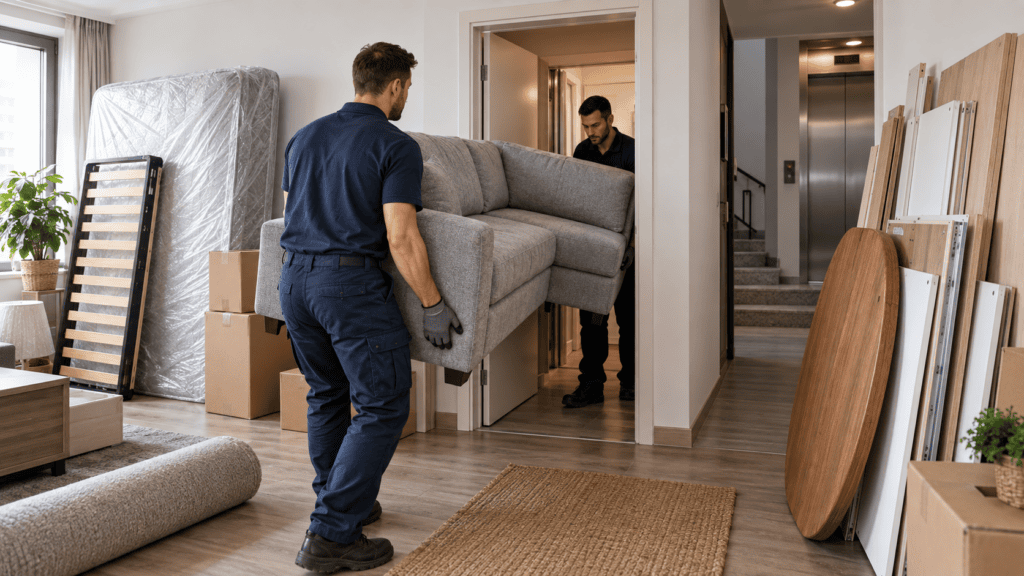
During a house move, some items stand out from the first glance. While it's usually easy to predict how to move items like boxes, chairs, or small tables, the same can't be said for a large corner sofa, a double bed frame, a spacious wardrobe, a solid wood dining table, or a single-piece bookcase. Especially in buildings with narrow doorways, small elevators, or limited stairwells, the first question that comes to mind for some furniture is often the same: "How are we going to get this out of here?"
This is where the most critical point of the large item moving process begins. Moving large and bulky furniture doesn't simply mean a few strong people can lift it. The size of the furniture, door opening, stair width, elevator cabin size, building entrance structure, how close the vehicle can get to the building entrance, and whether the furniture can be disassembled or not must all be considered. If even one of these details is overlooked, an unexpected problem can arise on moving day.
A sofa might fit out of a room but get stuck at a hallway turn. A wardrobe might pass through the door without being disassembled, but it might not fit in the building's elevator. Even if a large dining table fits in the elevator, its top might cause problems at the building entrance turn. A bed frame might fit out the bedroom door but couldn't change direction in the stairwell. Therefore, moving large items isn't a problem to be solved at the last minute, but a separate stage to be considered at the beginning of the moving plan.
With proper planning, moving large furniture becomes much more controlled. This requires first taking the actual measurements of the furniture, then checking the entry and exit routes. Items that can be disassembled should be identified, and alternative transport methods should be considered for furniture that cannot be disassembled. If necessary, the use of a lift, an external facade transport system, or additional personnel may also be part of the plan.
Why is moving large items different from moving regular items?
The main problem in moving large furniture isn't just weight. Volume, shape, and maneuverability often create bigger problems than weight. For example, a heavy box can be easily lifted by two people. However, a long tabletop, which can be considered relatively light, can be much more difficult to move out of a building if it cannot be repositioned in a narrow hallway.
When moving large items, three key factors come to the forefront: the size of the item, the size of the transit route, and whether the item can be disassembled.
A piece of furniture might be wide enough to fit through a doorway, but its depth might prevent a turn. Its height might be such that it gets caught on the ceiling in the stairwell. Its length might not be sufficient even if placed diagonally in the elevator cabin. Therefore, looking at only one measurement is not enough.
Before moving, the width, height, and depth measurements of large furniture should be taken separately. The space the furniture will occupy when rotated should also be considered.
Why should large items be measured before moving?
Taking measurements is one of the most important preparations for moving large items. However, many people don't consider how to move their furniture, which has been sitting in their home for years. Yet, when the furniture was first brought in, doors may have been removed, balconies used, or the items may have been disassembled beforehand.
Therefore, the idea that "if this furniture came in here, it must come out" is not always true.
After the furniture arrived, changes may have been made to the building or apartment. For example, the door frame may have been replaced, the elevator may have been changed, the stair railings may have been altered, or other items may have been added after the furniture was installed.
The following measurements should be taken for large items:
- Width
- Height
- Depth
- The longest fixed part
- Non-demountable body dimensions
These measurements should be used not only for the exit but also for the entrance in the new house.
Why might door dimensions be more important than furniture dimensions?
Just because a piece of furniture fits in a room doesn't mean it can fit through the doorway.
Door opening is particularly critical for items like sofas, bed frames, and large tables. Interior doors are often narrower than the building entrance.
When measuring a door, not only the external width of the door but also the actual usable opening should be measured.
Can the door leaf open completely?
Does the door handle restrict passage?
Is there a protruding frame?
Is there a wall or other obstacle immediately behind the door?
These questions are important when planning a large-scale move.
Why is it difficult to move a corner sofa?
Corner sofas are one of the most problematic pieces of furniture when moving house. This is because, in addition to their large size, their shapes are not standardized.
L-shaped sofas are often modular, but not every model is easily separated. While some corner sofas have two main parts that can be detached, others may have more complex connections.
Before transporting the chair, check if it is modular.
Can the legs be removed?
Is the armrest detachable?
Does the corner module come off the other parts?
If the bed has a mechanism, can it be locked in place?
These details determine the transportation method.
What to do if the corner sofa doesn't fit through the door?
If the chair doesn't fit straight through the doorway, forcing it shouldn't be the first solution.
The seat can be rotated at different angles.
The legs are detachable.
The cushions are removable.
The modular parts are detachable.
In some cases, temporarily removing the door leaf can provide a few extra centimeters of space.
However, removing the door frame is a more extensive process and requires professional assessment.
Trying to force the furniture through can damage the upholstery of the sofa, the door, and the wall.
Does removing the chair legs really make a difference?
Yes, in some cases even a few centimeters can be critical.
Especially with high-legged sofas, removing the legs reduces the height of the furniture and can make it easier to slide through doorways.
After the legs are removed, the screws should be stored in a separate bag.
The bag can be labeled with the seat name.
This simple method saves time during assembly in your new home.
Why are sofa beds heavier?
Sofa beds contain metal systems inside.
Therefore, even though they may look like standard seats from the outside, they can be heavier.
It is important to secure the mechanism so that it does not open during transport.
Large sofa beds may require support for three people instead of two.
Having an additional person can be helpful for guidance, especially when stairways are narrow.
Why Can Moving a Bed Base Be Difficult?
Bed bases are one of the most common problems encountered in the category of moving large items.
Double bed frames, in particular, are wide and heavy.
Some models consist of two parts, while others are a single large body.
The bed frame must be completely emptied before it is moved.
Leaving blankets, quilts, or other items inside will increase the weight and may damage the mechanism.
If the headboard is detachable, it must be removed.
The legs are removable.
The movable mechanism must be locked in the closed position.
What to do if a one-piece bed frame won't fit through the door?
This situation is especially common with older or large, custom-made bed bases.
First, the transition should be checked by rotating the base at different angles.
The door leaf can be temporarily removed.
However, if the bed frame still doesn't fit, a window or balcony can be considered as an alternative.
In high-rise buildings, this option requires professional equipment.
If an external lifting platform can be used, the bed frame can be removed through a balcony or large window.
However, for this method to be applicable, the building facade and the area in front of the building must be suitable.
Should the bed and bed frame be moved together?
No. The mattress and bed frame must be prepared separately.
The mattress should not be left on the bed frame.
The mattress can be covered with a clean protective cover.
The bed base, however, must be protected from scratches or dirt.
Heavy furniture should not be placed on the bed inside the vehicle.
Especially spring mattresses should not be folded forcefully if they are not suitable for that purpose.
Why are wardrobes one of the most critical pieces of furniture when moving large items?
Wardrobes are large, tall, and often heavy pieces of furniture. Moreover, they are generally not suitable for moving as a single unit.
For large wardrobes, disassembly is often the best solution.
The lids are removed.
The shelves are separated.
The side panels and top and bottom parts are removed.
The fasteners are packaged separately.
The panels are handled carefully.
This method significantly facilitates the passage of the wardrobe through doorways and stairs.
Can a wardrobe be moved without disassembling it?
This might be possible with small and robust models.
However, the risk is higher with large wardrobes.
The frame of a one-piece wardrobe may flex during transport.
The connection points may be damaged.
The lids can be opened.
Mirrored surfaces can break.
Changing direction on the stairs can be difficult.
Therefore, disassembling large wardrobes is often safer.
Is dismantling old wardrobes risky?
Yes, especially with particleboard or furniture that has been used for many years.
Screw holes may widen over time.
When disassembled furniture is reassembled, it may lose its original strength.
Therefore, in old wardrobes, the connection points should be checked before disassembly.
The value and lifespan of the furniture should also be taken into consideration.
In some cases, it might be more sensible to replace a large, old wardrobe instead of moving it into a new home.
How should mirrored wardrobes be moved?
Mirrored covers must be prepared separately and delicately.
The cover should be removed from the body if possible.
The mirror surface should be covered with a suitable protective material.
The corners can also be protected.
Heavy items inside the vehicle should not put pressure on the mirrors.
Mirrors or glass covers should not be left horizontally without being checked.
How to move a large dining table?
Large dining tables can be a problem, especially due to their wide tabletops.
If the legs are detachable, they should be removed before transport.
This allows the table to have a flatter shape and take up less space inside the vehicle.
The tabletop can be made of solid wood, glass, or marble.
Each material requires a different handling approach.
Solid wood tabletops can be heavy.
Glass tabletops are fragile and susceptible to breakage.
Marble slabs, however, can be both very heavy and fragile.
Therefore, the type of material must be taken into account when transporting a large table.
What precautions should be taken when moving a glass table?
The glass tabletop must be separated from the body.
The glass surface must be properly packaged.
Corners must be protected.
Heavy items should not be placed on top of the vehicle.
It should be transported in as controlled and stable a position as possible.
Professional handling assistance is especially important when working with large glass surfaces.
Why do marble tables require special attention?
Although marble is heavy, it can still break.
Therefore, one should not conclude that something is "sturdy" simply by looking at its weight.
Long marble slabs can crack if lifted from the wrong spot.
Adequate personnel and the correct lifting method must be used when handling these types of products.
How should large libraries be moved?
The bookshelf must first be completely emptied.
The bookshelf should not be moved along with the books.
The shelves are removable.
If the furniture can be disassembled, it can be taken apart.
Tall bookcases, in particular, can cause problems on stairs and at ceilings when moved in one piece.
Also, because the books themselves are heavy, they should be distributed into smaller boxes.
How do narrow doorways affect carrying large items?
Narrow doorways are one of the most common obstacles to carrying large items.
When large furniture arrives at the door, even a difference of a few centimeters can completely change the method of carrying it.
Therefore, the furniture dimensions should be compared with the door opening.
However, not only width but also the space where the furniture can be rotated is important.
If the hallway behind the door is very narrow, furniture may not be able to change direction even if it fits through the door.
How much space is gained if the door leaf is removed?
It depends on the door model.
In some cases, removing the door leaf from its hinges provides a few extra centimeters of space.
This small difference can make it possible to fit a large sofa or bed frame.
However, the procedure must be carried out carefully.
When the door is reinstalled, it should close properly.
Why can a narrow hallway be a bigger problem than a door?
Because the furniture might need to turn around after passing through the door.
Even if a long sofa can fit straight through a doorway, it may not be able to turn 90 degrees in a narrow hallway.
Therefore, aisle width and turning points must be carefully checked.
How should stair turns be measured?
The width of the steps alone is not enough for the staircase.
Platform width is important.
Ceiling height should be taken into consideration.
Handrail protrusions should be measured.
The distance between walls at floor turns should be checked.
Tall furniture can get stuck, especially in these spots.
How does a small elevator affect moving large items?
Even if the building has an elevator, it may not be usable for every item.
The elevator door may be narrow.
The cabin depth may be insufficient.
Tall furniture may not be able to be placed diagonally.
Therefore, the mere presence of an elevator is not sufficient information.
The cabin interior dimensions and door opening should be checked.
How to move items that don't fit in an elevator?
The first alternative is stairs.
If the ladder is suitable, the furniture can be moved safely by the team.
If the ladder is also unsuitable, it will be checked whether the furniture can be disassembled.
If dismantling is not possible, an external facade elevator or a suitable balcony/window exit can be considered.
When is an exterior facade elevator needed?
External facade elevators may be considered especially in the following situations:
High floor.
Narrow staircase.
Small building elevator.
Large armchair.
One-piece bed base.
Large furniture.
However, exterior facade elevators cannot be installed in every building.
There must be sufficient space in front of the building.
The vehicle must be able to approach the appropriate location.
Access to the balcony or window must be suitable.
There should be no trees, power lines, or other obstacles.
Can a balcony be used for moving large items?
In some cases, yes.
A wide balcony door, in particular, can be an alternative for moving large furniture.
However, carefully moving furniture from the balcony may require professional equipment.
Improvisational methods should definitely be avoided in high-rise buildings.
Can large items be taken out through the window?
It may be considered in some cases if the window opening is sufficient.
However, the window frame and glass structure should be carefully checked.
Lowering items from a height without professional equipment and safety precautions poses a serious risk.
How many people are needed to move a large item?
This number varies depending on the weight of the goods and the transportation route.
A large sofa can be carried by two people.
On a narrow staircase, guidance from a third person may be needed.
A heavy bed frame or solid table may require additional support.
Therefore, the number of team members should be determined not only by the size of the house, but also by the type of furniture that is most difficult to move.
Is it always better to have multiple people carry heavy objects?
No.
Too many people in confined spaces can make movement difficult.
The important thing is to have a sufficiently large and coordinated team.
Division of labor is important in a professional moving team.
It must be determined in advance who will carry the weight, who will direct the flow, and who will control the passage area.
Should vehicle selection be based on the size of the items to be lifted?
To a large extent, yes.
To ensure the vehicle can carry all the items, the largest and longest pieces must be considered.
For example, if the tabletop doesn't fit through the car door, having sufficient total space is meaningless.
If one module of the corner seat doesn't fit in your vehicle, you may need another vehicle.
Therefore, vehicle interior height, door opening, and loading space are important.
Should large items be squeezed into a small vehicle?
No.
Squeezing the furniture:
It can tear the fabric.
It can scratch wood.
It can damage the mechanism.
It can damage the car door.
It can crush other items.
The correct approach is to select the appropriate vehicle capacity.
How to Secure Large Items Inside a Vehicle?
Large pieces of furniture should be positioned so they don't move around inside the vehicle.
Heavy products must be positioned in a balanced manner.
Delicate surfaces should not come into direct contact with each other.
The gaps can be reinforced with suitable protective materials.
Sofa, bed base, and wardrobe panels should be positioned so as not to press against other items.
Why is packing important when moving large items?
Even if large furniture appears physically durable, its surfaces can be delicate.
Upholstery fabric can be damaged by friction.
Wardrobe panels can get scratched.
The table corner might get crushed.
The bed base fabric may get dirty.
Therefore, using appropriate protective packaging is important.
Why are corners especially important to protect?
The corners are the areas where furniture gets damaged the most.
Corners may come into contact with walls or other objects at doorways, stairways, and during vehicle loading.
Corner protectors can reduce this risk.
Should items be left inside large furniture?
Generally not.
The wardrobe must be completely emptied.
The dresser drawers should be empty.
Items inside the bed frame should be removed.
This both reduces weight and protects the furniture mechanism.
How to store screws for large furniture?
Each piece of furniture's connecting parts should be kept in a separate bag.
The product name should be written on the bag.
For example:
"Wardrobe screws"
"Headboard"
"Table legs"
This simple system saves significant time during installation in your new home.
Why is it necessary to take measurements for large furniture in a new home?
Removing furniture from the old house is only half the job.
The same furniture needs to fit in the new house.
Therefore, at the new address:
Building door.
Lift.
Stairs.
Apartment door.
Corridor.
Room door.
The area where the furniture will be placed
It should be measured.
What happens if furniture is being moved into a new house but doesn't fit in the room?
This can happen frequently.
Furniture can physically enter the home, but it can significantly reduce the usable space of the new room.
Therefore, the question should not be simply "Does it fit?", but also "Does it fit conveniently?".
This is especially important with large corner sofas and spacious wardrobes.
Is it more sensible to move or sell large furniture?
In some cases, moving old, large furniture may not be economical or practical.
The following factors can be considered when making a decision:
The value of the furniture.
The current situation.
Adapting to the new home.
Difficulty in transportation.
Risk of disassembly.
Alternative product cost.
Instead of moving an old, low-value piece of furniture that won't fit in your new home, it might be more sensible to sell it.
How to Classify Large Furniture Before Moving?
Furniture can be divided into four categories:
They're definitely moving.
They will be disassembled and transported.
Those requiring special transportation.
They will be sold or left behind.
This classification reduces the pressure of decision-making on transport day.
Can photos and videos be useful in large item planning?
Yeah.
A photograph of the furniture helps to understand its structure.
The short video shows the route from the room to the building entrance.
However, photographs and videos are no substitute for physical form.
Real measurements should be taken, especially at critical transitions.
The Most Common Mistakes When Moving Large Items
The most common mistake is not taking the measurements of the furniture.
The second mistake is only checking the room door and ignoring the hallway and stairs.
Another mistake is assuming that everything will fit just because there's an elevator.
Leaving furniture disassembly until the last minute can also prolong the moving process.
Furthermore, attempting to move heavy furniture without sufficient personnel is risky.
Choosing the wrong vehicle and forcing a large item into the vehicle also increases the likelihood of damage.
In what order should large items be removed on moving day?
The queue may vary depending on vehicle placement.
However, it's important to remove small items from around large furniture beforehand.
The moving team must have easy access to the furniture.
The wardrobe and table must be disassembled completely.
The mattress and bed frame must be prepared separately.
Fragile items should not be left under large furniture.
The interior layout of the vehicle should be designed with the emptying plan for the new house in mind.
Where should I leave large items when I arrive at my new home?
As directly as possible to the area where it will be used.
Leaving the large sofa in another room temporarily may require moving it again later.
Wardrobe panels should be kept in the room where they will be installed.
The bed frame should be carried directly into the bedroom.
The table should be taken to the area where it will be used.
Therefore, it is very helpful to prepare a floor plan of the new house before moving in.
Moving large items is one of the most delicate stages of a house move. For furniture like corner sofas, bed frames, wardrobes, large dining tables, or bookcases, not only weight but also size and transit conditions are crucial factors.
To avoid being faced with the question "How are we going to get this out of here?" on moving day, preparations should be made before the move.
The first step is to take the actual measurements of large pieces of furniture. The width, depth, height, and the longest fixed part should be measured separately.
Next, the route the furniture will take should be checked.
Apartment doors, hallways, stairs, landings, building elevators, and building entrance doors should all be considered together.
Whether the modular parts of the corner sofa can be separated, whether the headboard of the base can be removed, and whether the wardrobe can be disassembled should be determined in advance.
If there are narrow doorways or small elevators, alternative methods should be considered.
In some cases, simply removing the door leaf may be enough.
In some cases, the furniture may need to be completely disassembled.
If stairs are also unsuitable, an external facade lift can be considered.
The choice of vehicle should also be based on the size of the large furniture. It's important to consider not only the total volume but also whether the longest and widest piece will fit through the vehicle door.
When creating a city-wide large or partial load transportation plan through your transportation company, accurately sharing information such as the size of the items, address, floor, elevator, and whether transportation assistance is needed will facilitate the planning process.
When moving large furniture, the most important thing is not to resort to forceful solutions at the last minute, but to create a measurement and route plan beforehand.
When the right measurements, the right team, the appropriate tools, and sufficient preparation come together, even items that make you wonder, "How are we going to get this out of here?", can be moved in a much more controlled manner.